Tuesday, August 06, 2013

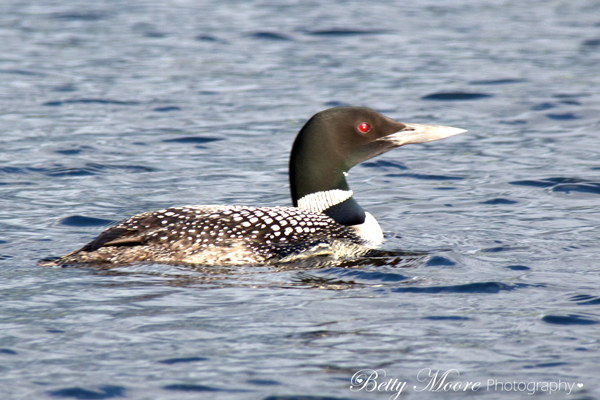
Baby Loon

Last year, in one of my blogs in September, I said that we don't see baby loons on our lake. However, this year we have. I'm wondering if we aren't seeing them when they are very little, but possibly we have seen them when they were bigger, and we didn't realize they were this year's babies. I was surprised to see one, especially with all of the flooding we had this spring. 

We were out in the boat near the end of July when we saw these two loons with their baby. They were keeping pretty close to it.


The baby loon is almost the size of the adults, but it doesn't have the colouring of the adult yet.  It was really nice to see.


I thought I'd also add a couple of pictures of one of the adults. 


This next one is looking down into the water watching for fish. We get to see them do this quite often out in front of our house.


As we watched the loons, they weren't nervous, but continued swimming around and doing some fishing. 

I'm so glad God gave us creatures like this to enjoy.

Praise the Lord! For it is good to sing praises to our God; 
for it is pleasant, and a song of praise is fitting. 
~ Psalm 147:1

Tuesday, July 30, 2013

Fragrant Water Lily

I was recently given a fragrant water lily (or white water lily) from my grandson, who picked it out of our lake. They float on our lake, and you see them in several areas. The leaves and the flowers float on the surface of the lake, and the roots reach down into the soil. Usually the water isn't very deep where they are. The flowers open during the morning and early afternoon, and close up for the night.


 Some of the things I learned while checking for information were quite interesting. You can eat the flowers, leaves, and ripe seeds when they are raw. I'm not sure that I want to try them or serve them in my home, but this is what http://northernbushcraft.com stated. They also say that the flowerbuds can be cooked, and the rhizome (roots) can be boiled or roasted. I don't think I realized we had such a garden out in our lake.


A close up shows the yellow centre, which really adds to the look of the flower.

The next two pictures were taken with my 50 mm lens, as I'm still learning to use it. It gives a much smaller DOF (Depth of Field), which can make the picture look interesting. All of these were taken outside with natural light. They were not taken in the lake - I used a couple of different containers when taking the photos.


Tuesday, July 23, 2013

The Busy Bumble Bee

I don't claim to be an expert about bumblebees. Our hydrangea is in full bloom, and the bees are very busy gathering pollen from it. Normally I avoid it because of allergies to wasps, etc., but this time I noticed many, many bumblebees, so thought I would try taking some photos.


 The bumble bee's body is much thicker than a wasp and is hairy. I didn't know before that only the female's have stingers. The male (drone) does not have a stinger. However, the females can sting again and again since they don't have a barbed hook on their stinger.


Their hind legs are designed to carry pollen, which you can see in the picture below. They only make enough honey for them to live on during the summer as all of them die except for the queen bees when it is fall. The queen bee then finds a place to hibernate for the winter, lays her eggs in the spring, and the cycle starts again. 


It's difficult to get a picture of a complete bumblebee as they burrow their heads into the flowers almost as soon as they land.


There are about 250 species in the world, and Canada has about 41.


The bumblebee gathers nectar and pollen from a variety of flowers. Apparently they prefer blue flowers, but will go to any colour. Colour certainly doesn't seem to affect them around the hydrangea. 

Compared to honey bees, their hives are relatively small. There are usually 150 - 200 bees and the hives are usually found underground in abandoned burrows. They will defend their hives, but they do not swarm. 


I think it's amazing how the bumble bees fly. Apparently they create a vortex of air with the down stroke of their wings. Sometime I'll have to try a faster shutter speed to catch the wings. They can fly at a rate of three metres in a second.

There is much more to learn about a bumble bee. Even in something as small as a bumble bee, you can see the hand of God at work.


Tuesday, July 16, 2013

The Tawny Daylily

 The tawny daylily (which we often refer to in our area as the common daylily) is also known as the roadside daylily, the railroad daylily, ditch lily, and even the outhouse lily. This is because it will grow just about anywhere. I remember it growing near my grandmother's outhouse, but we never called it the outhouse lily at the time.


It's very common in this area, and people often consider it a weed because it's so invasive. It does take over gardens and crowds other plants out. It is not as showy as some of the hybrid lilies, but I enjoy seeing its bright colour along ditches and in gardens. 

I'm glad that it is invasive. This means it will grow in the soil we have here, and I never have to do anything with it. It just keeps coming every year. It is best to put it in an area where you don't have to worry about it taking over.


When the flower has the right lighting on it, it looks quite beautiful with the variety of yellows and oranges. The flowers do not last long. Usually they open in the morning, and wither during the night.  


Often we take things for granted, and don't look at them very closely. When we take the time, we can see God's handiwork. Even a flower that is considered a weed in many parts of the world is beautiful. It is amazing how He has made so many flowers with such intricate detail. 


Tuesday, July 09, 2013

Robins and Eggs


I learned some new things about robins this year. Apparently, robins lay one egg per day over a period of 4-5 days. They often let the eggs cool until all of the eggs are laid, and then sit (brood) on the nest. This way, the eggs all hatch around the same time. I did read one article that said they hatch in the order they were laid. 

When we were in Leamington, Ontario in the spring, we saw a robin's nest with three eggs in it. The colour of the eggs is really fascinating to me - it's such a beautiful sky blue.


A couple of days later, we checked the nest again, and this time there were 5 eggs. Apparently this is more than the normal number and is rare. Sometimes another robin has actually laid one of the eggs.


The male robin does not sit on the nest, but stays close by. If the female gives a cry of alarm, the male will come to help her. The robins mate for the season and raise 2-3 nestings. They do not usually mate for life. 


The female stays on the nest for about 12 - 14 days. She doesn't leave the nest except for short periods. Usually she gets her own food, but sometimes  the male brings food to her. 


Robins who manage to live past their first year might make it to 5 or 6 years at the most. Most migrate to the southern states, but some stay in Canada through the winter, and move around to different food sources. They eat fruit in the winter; insects and worms in the warmer weather.

We are so used to seeing robins in our area that we don't pay much attention to them. But their way of life is interesting when we look at it. 

For by Him (God), all things were created ... 
Colossians 1:16


Monday, July 01, 2013

Infant Pictures

I don't often get a chance to take infant pictures, so was happy to have the chance this past week to get some practice. This little one slept most of the time. 


God created man in his own image ... Genesis 1:27


Tuesday, June 25, 2013

Hummingbirds

We have ruby-throated hummingbirds in our area. I've been trying to photograph them over the years, and was looking on the internet for suggestions about how to get good pictures of them. They've been really busy here in the last week or so, but of course, when I was hoping to see them and take photos, it's almost as if they've disappeared. They must be sitting on the eggs right now.

One of the suggestions was to use my flash and underexpose the ambient lighting, so this is what I tried. These pictures were taken in the daytime even though some look like they were taken at night. I will try to take more throughout the summer and hopefully will improve my technique. 

The male has a red or ruby throat  which shows up at different times, depending on how the light hits it. 


They are so tiny and yet so aggressive with each other. The males will often sit on a stalk (like the one above) and guard the hummingbird feeders. They aren't always drinking from it, but they don't want any other bird to use the feeder. I found it difficult to get a picture of them flying, so I guess that will be my goal for awhile. 


The female does not have the ruby throat and looks different in the throat area. They can be quite aggressive too.


It's so good to know that God knows us and loves us. He knows all the birds of the hills, which is amazing because there are so many of them, and so many different kinds.