Tuesday, September 03, 2013

Great Spangled Fritillary

I believe this is a Great Spangled Fritillary butterfly. They are located in southern Canada and in the United States. It was flying in and around the flowers in my backyard.  


God has made everything 
beautiful in its time.
~ Ecclesiastes 3:11 ~

Tuesday, August 27, 2013

Hummingbird Hawk Moth

I heard what I thought was a hummingbird in my garden, but it wasn't big enough to be one. Instead it was a hummingbird moth. They are interesting to watch as they flit around from flower to flower. However, I found it very difficult to take a sharp photo of it because of its speed. Although the following pictures are not as sharp as I would like, I thought I would put them on here because of how rare it is for us to see these in our area.


Monday, August 19, 2013

Mother Robin and her Babies

We were visiting my father in Burk's Falls a couple of weeks ago, and I was able to capture some photos of a robin feeding her young ... or maybe it was the father feeding his young. The  robin was quite curious about me taking pictures, but was not very nervous. She is used to my dad walking around, and mowing the lawn near the nest.

The nest is built under the eaves of a shed, and is sitting on top of a ladder that's hanging on the shed. I think the baby robins aren't very pretty, but it doesn't matter to the parents. They were certainly ready for food each time the robin came.


I'm glad I can add these photos to my collection of robin photos. It was interesting watching the adult birds care for their young. God cares for each of us, far more than the robin cares for its young. This is a wonderful thought.

Tuesday, August 13, 2013

Cedar Waxwings

Cedar Waxwings are usually shy. We see them very rarely, and when we do, it is difficult to get good photos of them. They are usually peaking at you from behind leaves, like this one, or they fly away as soon as you look like you're going their direction.


I love their song. If you go to http://www.allaboutbirds.org/guide/cedar_waxwing/id and scroll down their page, you can hear it for yourself.


They are a pretty bird, so it's well worth taking the time to be able to see them. 


Look at the birds of the air: they neither sow nor reap nor gather into barns, 
and yet your heavenly Father feeds them. 
Are you not of more value than they?
~ Matthew 6:26

Tuesday, August 06, 2013

Baby Loon

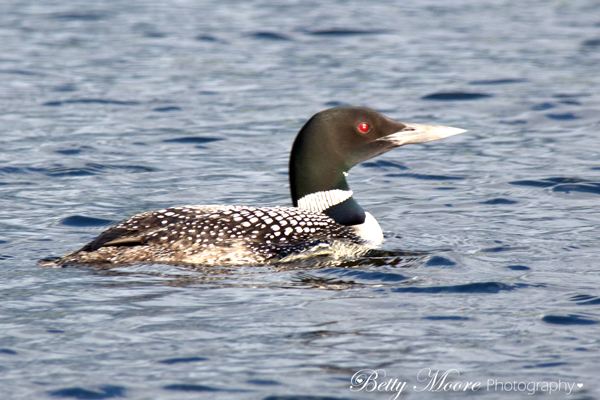
Last year, in one of my blogs in September, I said that we don't see baby loons on our lake. However, this year we have. I'm wondering if we aren't seeing them when they are very little, but possibly we have seen them when they were bigger, and we didn't realize they were this year's babies. I was surprised to see one, especially with all of the flooding we had this spring. 

We were out in the boat near the end of July when we saw these two loons with their baby. They were keeping pretty close to it.


The baby loon is almost the size of the adults, but it doesn't have the colouring of the adult yet.  It was really nice to see.


I thought I'd also add a couple of pictures of one of the adults. 


This next one is looking down into the water watching for fish. We get to see them do this quite often out in front of our house.


As we watched the loons, they weren't nervous, but continued swimming around and doing some fishing. 

I'm so glad God gave us creatures like this to enjoy.

Praise the Lord! For it is good to sing praises to our God; 
for it is pleasant, and a song of praise is fitting. 
~ Psalm 147:1

Tuesday, July 30, 2013

Fragrant Water Lily

I was recently given a fragrant water lily (or white water lily) from my grandson, who picked it out of our lake. They float on our lake, and you see them in several areas. The leaves and the flowers float on the surface of the lake, and the roots reach down into the soil. Usually the water isn't very deep where they are. The flowers open during the morning and early afternoon, and close up for the night.


 Some of the things I learned while checking for information were quite interesting. You can eat the flowers, leaves, and ripe seeds when they are raw. I'm not sure that I want to try them or serve them in my home, but this is what http://northernbushcraft.com stated. They also say that the flowerbuds can be cooked, and the rhizome (roots) can be boiled or roasted. I don't think I realized we had such a garden out in our lake.


A close up shows the yellow centre, which really adds to the look of the flower.

The next two pictures were taken with my 50 mm lens, as I'm still learning to use it. It gives a much smaller DOF (Depth of Field), which can make the picture look interesting. All of these were taken outside with natural light. They were not taken in the lake - I used a couple of different containers when taking the photos.


Tuesday, July 23, 2013

The Busy Bumble Bee

I don't claim to be an expert about bumblebees. Our hydrangea is in full bloom, and the bees are very busy gathering pollen from it. Normally I avoid it because of allergies to wasps, etc., but this time I noticed many, many bumblebees, so thought I would try taking some photos.


 The bumble bee's body is much thicker than a wasp and is hairy. I didn't know before that only the female's have stingers. The male (drone) does not have a stinger. However, the females can sting again and again since they don't have a barbed hook on their stinger.


Their hind legs are designed to carry pollen, which you can see in the picture below. They only make enough honey for them to live on during the summer as all of them die except for the queen bees when it is fall. The queen bee then finds a place to hibernate for the winter, lays her eggs in the spring, and the cycle starts again. 


It's difficult to get a picture of a complete bumblebee as they burrow their heads into the flowers almost as soon as they land.


There are about 250 species in the world, and Canada has about 41.


The bumblebee gathers nectar and pollen from a variety of flowers. Apparently they prefer blue flowers, but will go to any colour. Colour certainly doesn't seem to affect them around the hydrangea. 

Compared to honey bees, their hives are relatively small. There are usually 150 - 200 bees and the hives are usually found underground in abandoned burrows. They will defend their hives, but they do not swarm. 


I think it's amazing how the bumble bees fly. Apparently they create a vortex of air with the down stroke of their wings. Sometime I'll have to try a faster shutter speed to catch the wings. They can fly at a rate of three metres in a second.

There is much more to learn about a bumble bee. Even in something as small as a bumble bee, you can see the hand of God at work.